 Loading Please Wait...Loading Please Wait...
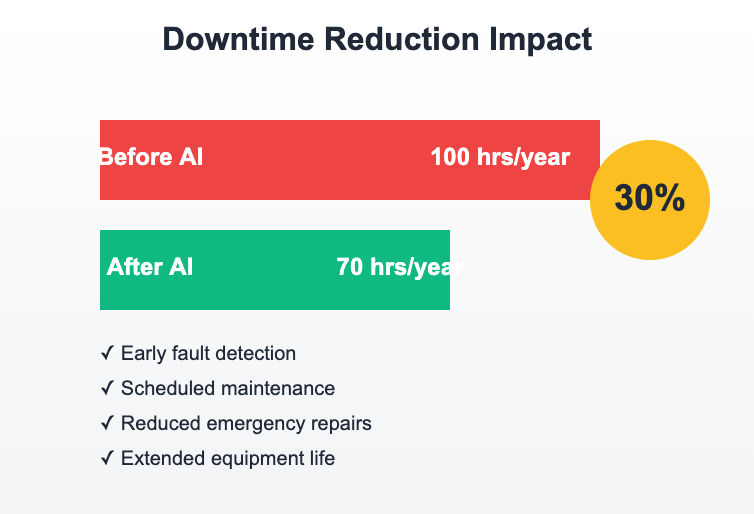
In cold chain logistics, a single freezer failure can mean thousands of dollars in spoiled goods, broken contracts, and damaged reputations. Traditional maintenance schedules and reactive repairs simply aren't enough anymore. That's where predictive maintenance AI is transforming the industry—delivering up to 30% reductions in downtime while protecting valuable inventory and cutting maintenance costs.
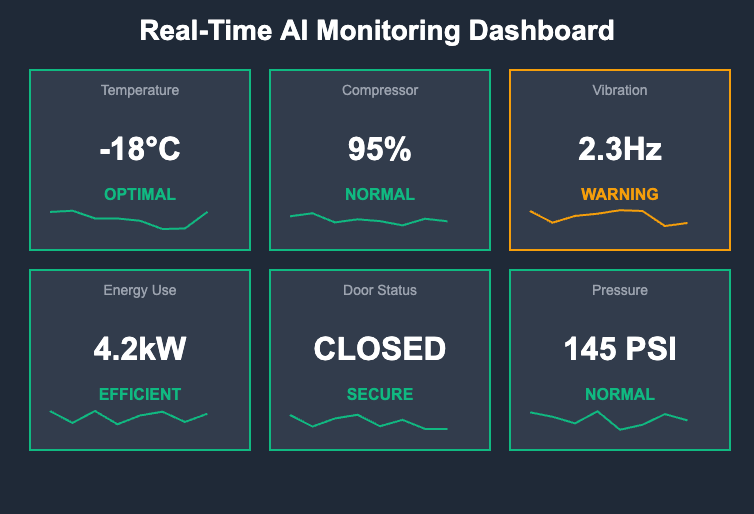
Cold chain logistics operates on razor-thin margins where temperature control isn't just important—it's everything. When a commercial freezer goes down, the clock starts ticking immediately. Pharmaceutical companies face FDA violations, food distributors watch inventory spoil, and logistics providers scramble to transfer products to backup facilities.
The financial impact extends beyond lost inventory. Emergency repairs cost three to five times more than planned maintenance. Expedited parts shipping, overtime labor, and emergency technician callouts add up quickly. Meanwhile, customers lose confidence, contracts include penalty clauses, and insurance premiums rise after incidents.
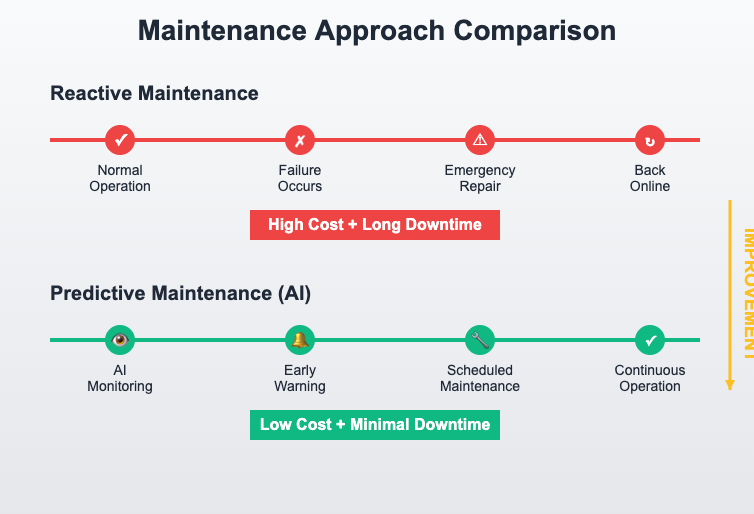
Traditional preventive maintenance helps, but it's inefficient. Technicians service equipment on fixed schedules regardless of actual condition, replacing parts that still have useful life while potentially missing components that are about to fail.
Predictive maintenance AI transforms freezer management from reactive firefighting to proactive optimization. The technology combines Internet of Things sensors, machine learning algorithms, and real-time data analysis to predict equipment failures before they happen.
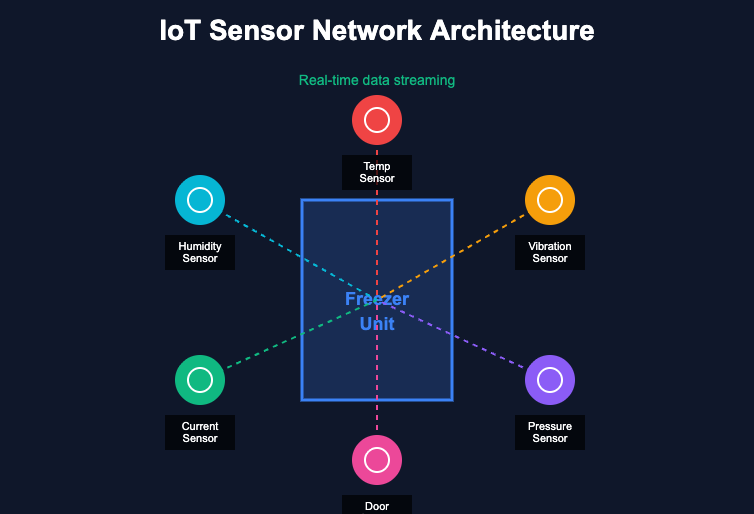
Modern commercial freezers get equipped with multiple sensors monitoring critical parameters around the clock. Temperature sensors track internal conditions at multiple points, vibration sensors on compressors detect bearing wear and imbalance, current sensors identify electrical anomalies, pressure sensors monitor refrigerant levels and flow, door sensors track opening frequency and duration, and humidity sensors watch for seal degradation.
These sensors generate massive amounts of data—thousands of readings per hour from each freezer unit. AI algorithms trained on historical failure patterns analyze this constant stream of information, learning what normal operation looks like and identifying subtle deviations that signal impending problems.
The system builds predictive models for each component based on operating conditions, usage patterns, environmental factors, maintenance history, and equipment age. When sensor readings indicate a developing issue, the AI calculates failure probability, estimates time until failure, and prioritizes maintenance actions.
The 30% downtime reduction isn't marketing hype—it comes from fundamental changes in how maintenance gets executed. Several factors contribute to this dramatic improvement.
Early detection catches problems in their earliest stages, allowing technicians to schedule repairs during low-activity periods rather than responding to emergency breakdowns. Components get replaced before they fail catastrophically, preventing the cascading damage that extends repair time. Maintenance teams arrive with the correct parts and tools already identified by the AI system, eliminating diagnostic time and multiple service calls.
A major pharmaceutical distributor implemented predictive maintenance AI across their cold storage network of 150 freezer units. In the first year, unplanned downtime dropped by 32%. More importantly, they eliminated all incidents of temperature excursions that would have compromised product integrity. The system predicted 47 compressor failures with an average lead time of 12 days, allowing scheduled repairs during overnight hours.
A regional food distribution center saw similar results. Their AI system identified a pattern of door seal degradation correlated with specific loading dock positions. By addressing the root cause—excessive vibration from nearby equipment—they prevented dozens of potential failures. Their total maintenance costs actually decreased by 18% despite more frequent interventions, because they avoided expensive emergency repairs.
The advantages of predictive maintenance AI extend well beyond reducing downtime. Energy efficiency improves significantly when systems catch performance degradation early. A freezer with a failing compressor or refrigerant leak might maintain temperature but consume 20-40% more electricity. AI identifies these efficiency losses before they become obvious, recovering energy costs that often exceed maintenance savings.
Inventory protection becomes more reliable. Temperature excursions—even brief ones—can compromise product quality in ways that aren't immediately visible. Predictive maintenance prevents the gradual degradation that traditional monitoring might miss. For pharmaceuticals and biologics where temperature logs are regulatory requirements, this provides documented proof of proper storage conditions.
Equipment lifespan extends when problems get addressed before they cause secondary damage. A worn compressor bearing caught early might require a simple bearing replacement. Left undetected, it can destroy the entire compressor, damage the motor, and contaminate the refrigerant system. The AI's ability to catch these issues early translates directly into capital expense savings.
Maintenance staff become more efficient. Instead of following rigid schedules or responding to emergencies, technicians receive prioritized work orders with specific diagnostic information. They know exactly what to fix, what parts to bring, and how urgent the issue is. This transforms maintenance from a cost center into a strategic operation.
Deploying predictive maintenance AI requires thoughtful planning. The initial investment includes sensor installation, network infrastructure, AI platform subscription or licensing, integration with existing management systems, and staff training.
However, the return on investment typically appears within 12-18 months for facilities with more than 20 commercial freezer units. Smaller operations can still benefit through third-party monitoring services that spread costs across multiple customers.
Data quality determines system effectiveness. The AI needs sufficient historical data to build accurate models—typically 6-12 months of sensor readings along with maintenance records. Facilities transitioning from basic monitoring should expect a learning period where the system refines its predictions.
Integration with existing workflows matters tremendously. The best AI systems don't create isolated alerts that maintenance managers must manually track. They integrate with computerized maintenance management systems, automatically generate work orders, track parts inventory, and close the feedback loop by recording repair outcomes to improve future predictions.
Staff buy-in is essential. Maintenance technicians sometimes resist systems they perceive as replacing their expertise. Successful implementations position AI as a tool that enhances their capabilities rather than threatens their roles. When technicians see the AI helping them prevent failures and make their jobs easier, adoption accelerates.
Not all predictive maintenance AI platforms are created equal. When evaluating solutions for cold chain applications, several factors deserve careful consideration.
Cold chain expertise matters. Generic industrial predictive maintenance systems don't understand the specific failure modes of commercial refrigeration equipment. Look for platforms with models trained specifically on freezer and refrigeration data.
Sensor ecosystem flexibility allows you to leverage existing monitoring equipment while adding specialized sensors where needed. The best platforms support multiple sensor types and communication protocols rather than requiring proprietary hardware.
Alert accuracy and lead time determine practical value. A system that predicts failures accurately but only hours in advance doesn't provide enough time to prevent downtime. Target solutions that provide 7-14 day advance warnings with prediction accuracy above 85%.
Scalability accommodates growth. Cloud-based platforms that charge per unit or per sensor scale naturally as your facility expands. On-premise solutions might have lower ongoing costs but require more internal IT resources.
Predictive maintenance AI continues evolving rapidly. Next-generation systems incorporate additional capabilities that promise even greater improvements.
Automated diagnostics are becoming more sophisticated. Instead of just flagging an anomaly, AI systems increasingly provide specific repair recommendations, estimated repair times, and parts lists. Some platforms now integrate with parts suppliers to automatically order components when failure predictions exceed certain thresholds.
Prescriptive maintenance takes the next step beyond prediction. These systems don't just forecast when equipment will fail—they recommend optimal maintenance timing based on inventory levels, product criticality, staff availability, and operational schedules. The AI optimizes maintenance across your entire facility rather than treating each freezer independently.
Digital twins create virtual replicas of each freezer unit, allowing operators to simulate different scenarios and test maintenance strategies without risking real equipment or inventory. This enables continuous improvement of maintenance procedures and more accurate long-term capital planning.
Integration with broader supply chain systems enables coordinated decision-making. When a freezer shows signs of potential failure, the system can automatically reroute incoming shipments, adjust inventory allocation, or notify downstream partners—all before any temperature deviation occurs.
For cold chain operators considering predictive maintenance AI, starting small often makes sense. Select a pilot group of critical freezer units—perhaps your largest capacity units or those storing your most valuable inventory. Implement comprehensive monitoring and let the AI system learn your baseline operations for several months.
Track specific metrics during the pilot: unplanned downtime incidents, emergency service calls, energy consumption, maintenance costs, and temperature excursions. Compare these against historical data and control units without AI monitoring. Most facilities see measurable improvements within six months that justify expanding the system.
Build internal expertise gradually. Designate champions within your maintenance team who understand both the technology and your operational needs. These individuals become your interpreters—translating AI insights into actionable maintenance decisions and providing feedback that improves system accuracy.
Partner with vendors who offer support during implementation. The learning curve for predictive maintenance AI isn't steep, but having expert guidance during the initial months accelerates success and helps you avoid common pitfalls.
The 30% downtime reduction that predictive maintenance AI delivers in cold chain logistics isn't just about preventing freezer failures—it's about fundamentally transforming how facilities manage their most critical assets. By moving from reactive repairs and inefficient scheduled maintenance to data-driven predictive interventions, operators protect inventory, reduce costs, improve energy efficiency, and extend equipment life.
The technology has matured beyond early adoption phase. Proven platforms with demonstrated ROI are readily available, and implementation has become more straightforward. For cold chain operators still relying on traditional maintenance approaches, the question isn't whether to adopt predictive maintenance AI, but how quickly they can implement it before competitors gain an insurmountable advantage.
In an industry where a few degrees can mean the difference between profit and loss, between compliance and violation, between satisfied customers and broken contracts, predictive maintenance AI has become less of a competitive advantage and more of an operational necessity.

 Oriya
Oriya