 Loading Please Wait...Loading Please Wait...
Choosing the right cloud provider is one of the most important decisions for your startup. It affects your costs, speed, security, and how fast you can grow. This guide makes it simple to understand and compare the best options for Indian startups in 2025.

Cloud computing lets you use powerful computers and storage without buying expensive hardware. You pay only for what you use, and you can scale up or down instantly. For startups in India, this means:
1. Amazon Web Services (AWS)
Best for: Startups that need variety and want to grow globally
AWS is the biggest cloud provider in the world and very popular in India. They have data centers in Mumbai and Hyderabad.
What's good:
What's not so good:
Pricing: Pay as you go. Free tier available for 12 months. Startup credits through AWS Activate program.
Indian presence: Data centers in Mumbai and Hyderabad ensure low latency and data compliance.
Best use case: If you're building something complex or plan to scale internationally, AWS is your best bet.
2. Microsoft Azure
Best for: Startups already using Microsoft products (Office 365, Windows)
Azure works very well if your team already uses Microsoft tools. It's the second largest cloud provider globally.
What's good:
What's not so good:
Pricing: Pay as you go. Free tier available. Startup credits through Microsoft for Startups program.
Indian presence: Multiple data centers in India with strong local support.
Best use case: If you're building enterprise software or your team uses Microsoft tools, Azure makes sense.
Best for: Startups focused on data, AI, and machine learning
Google Cloud is the third biggest but growing fast. It's especially strong in data analytics and AI.
What's good:
What's not so good:
Pricing: Generally 20-30% cheaper than AWS for similar services. Free tier and startup credits available.
Indian presence: Data center in Mumbai ensures good performance for Indian users.
Best use case: Perfect if you're building AI/ML products, working with lots of data, or want modern container-based architecture.
Best for: Budget-conscious startups wanting local support
Utho is an Indian cloud provider that understands local needs and offers much lower prices than global players.
What's good:
What's not so good:
Pricing: Very affordable, typically 40-60% less than major providers. Clear, simple pricing structure.
Indian presence: Fully Indian company with local data centers and support.
Best use case: If budget is your main concern and you don't need complex global infrastructure, Utho is excellent value.
Best for: AI/ML startups needing GPU computing
E2E Networks is another Indian cloud provider specializing in GPU cloud services, which are essential for AI and machine learning work.
What's good:
What's not so good:
Pricing: Competitive, especially for GPU instances. Pay in rupees, no foreign exchange hassles.
Indian presence: Completely Indian company with data centers in India.
Best use case: If you're building AI/ML products and need affordable GPU computing power.
1. Your Budget
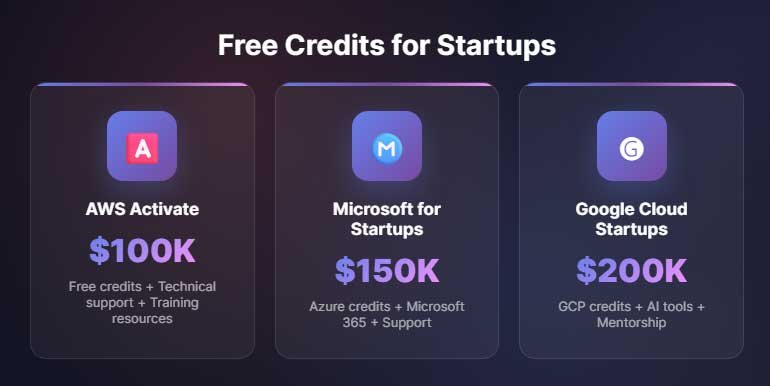
If money is tight: Start with Utho or use the free tiers from AWS/GCP. Most cloud providers give $1,000-$5,000 in free credits to startups.
If you have funding: AWS or GCP give you more flexibility and features to grow.
2. Your Technical Skills
Beginners: Utho has the simplest interface. Google Cloud is also easier to learn than AWS.
Experienced teams: AWS offers the most services and flexibility.
3. What You're Building
Simple website/app: Any provider works. Choose based on price (Utho) or free credits (AWS/GCP).
AI/Machine Learning: Google Cloud or E2E Networks are your best options.
Enterprise software: Azure if you use Microsoft tools, otherwise AWS.
Big data analytics: Google Cloud (BigQuery is excellent).
4. Data Compliance
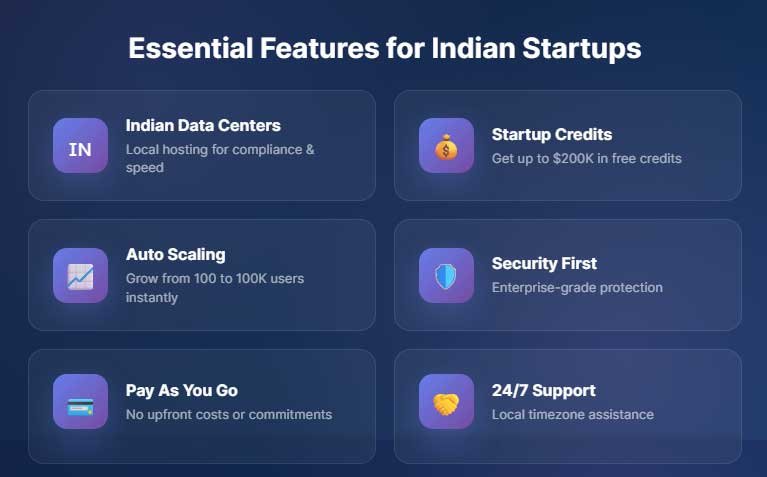
All major providers now have Indian data centers, so your data can stay in India to comply with regulations. This is important for:
AWS Activate
Microsoft for Startups
Google Cloud for Startups
Pro tip: Many startups get accepted to multiple programs and use free credits from different providers for different purposes.
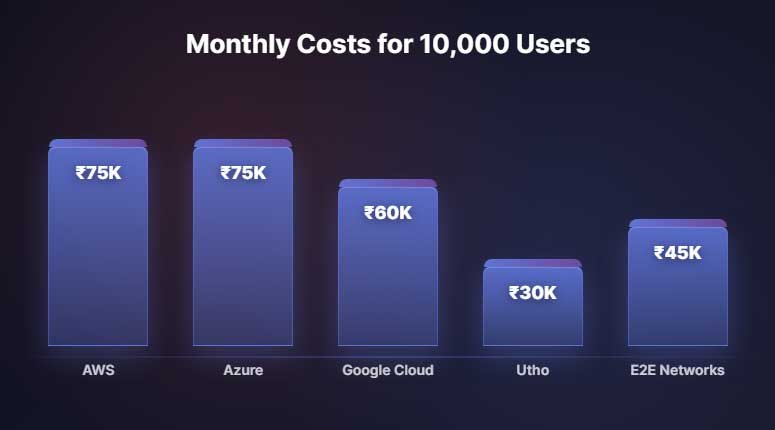
Here's what it costs to run a typical startup app (rough estimates):
Small startup (1,000 users):
Medium startup (10,000 users):
Growing startup (100,000 users):
Note: Actual costs vary based on your specific usage, optimization, and services used.
Step 1: Do you need AI/ML and data analytics?
Step 2: Are you using Microsoft tools (Office, Teams)?
Step 3: Is budget your biggest concern?
Step 4: Do you plan to scale globally?
1. Not using free credits Apply to startup programs BEFORE you start spending your own money.
2. Ignoring cost optimization Cloud costs can spiral quickly. Use cost monitoring tools from day one.
3. Choosing based on hype Just because everyone talks about AWS doesn't mean it's right for you. Choose based on YOUR needs.
4. Not considering data location Make sure your provider has Indian data centers if you need local data storage.
5. Over-engineering early Start simple. You don't need all the fancy features on day one.
Can you switch later? Yes, but it's work. Here's how hard it is:
Easy migrations:
Hard migrations:
Smart approach: Build in a cloud-agnostic way if possible, so switching is easier later.
For most Indian startups, here's our recommendation:
Just starting & learning: Use Google Cloud free tier. It's easier to learn and has generous free credits.
Budget is critical: Go with Utho. You'll save 50-60% compared to big providers.
Building AI/ML: Choose Google Cloud for tools and ease, or E2E Networks for affordable GPU power.
Need enterprise features: Pick Azure if you use Microsoft, otherwise AWS.
Planning global scale: AWS has the most locations and services worldwide.
Learning resources:
Indian startup communities:
Cost calculators:
There's no single "best" cloud provider. The right choice depends on:

 Oriya
Oriya